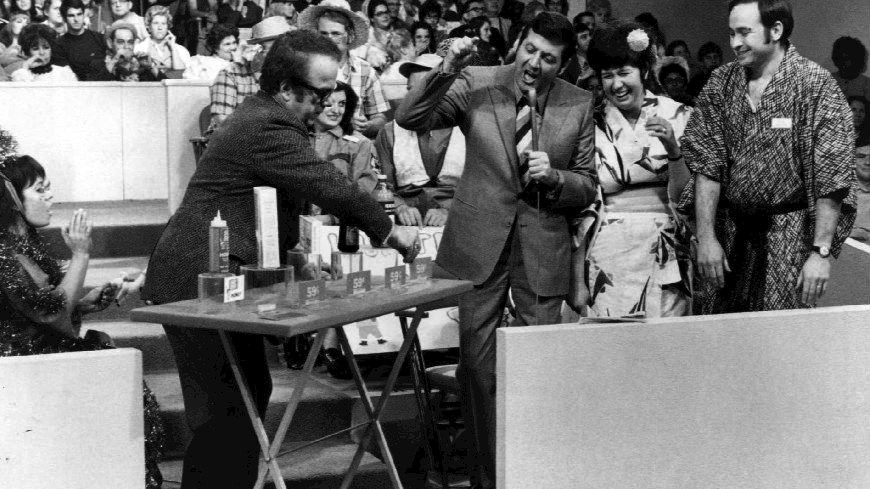
 Image: ABC Television, public domain
Monty Hall, settled by counting
You are on a game show. There are three closed doors; behind one is a car, behind the other two are goats. You pick door 1. The host, who knows where the car is, opens door 3 and shows you a goat. He offers you the chance to switch to door 2. Should you?
Most people say it makes no difference: two doors left, one car, 50 to 50. The correct answer is that switching wins two times in three. This article counts the cases, because counting is the only argument that convinces anybody, and then looks at why the problem caused such a row in 1990 and what assumption the answer depends on.
The nine cases
The car is behind door 1, 2, or 3 with equal probability, and you pick door 1, 2, or 3 with equal probability, which gives nine equally likely combinations. In each, the host opens a door that you did not pick and that has a goat, and you either stay or switch. Here is what happens if you always switch.
| Car behind | You pick | Host opens | Switch to | Result of switching |
|---|---|---|---|---|
| 1 | 1 | 2 or 3 | the other | goat |
| 1 | 2 | 3 | 1 | car |
| 1 | 3 | 2 | 1 | car |
| 2 | 1 | 3 | 2 | car |
| 2 | 2 | 1 or 3 | the other | goat |
| 2 | 3 | 1 | 2 | car |
| 3 | 1 | 2 | 3 | car |
| 3 | 2 | 1 | 3 | car |
| 3 | 3 | 1 or 2 | the other | goat |
Switching wins in six of the nine cases and loses in three. Staying does the opposite. The pattern is visible in the table: switching loses exactly when your first pick was right, which happens one time in three, and wins whenever your first pick was wrong, which happens two times in three.
That last sentence is the whole argument in one line. Your first choice is right with probability one third, and nothing the host does changes that, because he can always open a goat door whatever you picked. So the car is behind one of the other two doors with probability two thirds, and the host has just told you which of those two it is not.
The hundred doors
If the table does not convince, scale the problem up. There are 100 doors, one car. You pick door 1. The host, who knows where the car is, opens 98 of the remaining 99 doors, all goats, and leaves door 57 closed. Do you switch to door 57? Your first pick was right one time in a hundred. The host has carefully stepped around door 57 while opening everything else. Almost everyone switches at 100 doors, and the three-door case is the same logic with less drama.
The letters of 1990
The problem is named after Monty Hall, the host of the American television show Let's Make a Deal from 1963, though the show's actual rules were looser than the puzzle's. The statistician Steve Selvin posed it in a letter to The American Statistician in 1975. It became famous in September 1990, when a reader asked it of Marilyn vos Savant in her column in Parade magazine and she answered: switch.
About 10,000 letters followed, roughly a thousand of them from people with doctorates, and most said she was wrong. Several were from mathematicians and were not polite. Vos Savant answered twice more, with the table above and with an appeal to teachers to run the experiment in class with three cups and a coin, and the classroom results came in at two thirds. Her account of the episode, with the letters, is archived online. Paul Erdős, one of the great mathematicians of the century, is reported to have refused to believe the answer until he was shown a computer simulation.
Why do so many careful people get it wrong? The error is to treat the host's action as uninformative. Two doors remain, so the mind assigns them equal probability, as it would if a stranger had opened a random door and found a goat by luck. The host did not act at random. He was constrained to avoid both your door and the car, and a constrained choice carries information.
The assumption that matters
The answer of two thirds depends on the rules of the game, and the rules must be stated. The host always opens a door; he always opens a door you did not pick; the door he opens always has a goat; and when he has a choice of two goat doors he picks between them at random. Change any of these and the answer changes.
Suppose the host does not know where the car is. He opens one of the two doors you did not pick at random, and it happens to show a goat. Now count again. Of the nine cases, the host sometimes opens the car door; those cases are excluded, because we are told he showed a goat. Among the cases that remain, your door and the other closed door hold the car equally often. Switching wins exactly half the time. This version is sometimes called Monty Fall, because the host might as well have slipped and opened a door by accident. The difference between the two versions is the difference between a host who knows and a host who guesses, and only the one who knows gives you information.
Or suppose the host offers the switch only when your first pick was right, because he wants to keep the car. Then switching always loses. The puzzle as usually stated rules this out, and vos Savant's answer assumed the standard rules, which is one reason the argument went on for so long: some of her critics had different rules in mind and never said so.
What the problem teaches
Conditional probability is the probability of one thing given that you know another, and the Monty Hall problem is the cleanest demonstration that what you know depends on how you came to know it. A goat behind door 3, revealed by a host who was forced to avoid the car, means something different from a goat behind door 3 revealed by accident, even though the picture in front of you is identical.
The same point decides what a positive medical test means, where the probability of disease given a positive result depends on how often the test is positive in healthy people, and it decides what a surprising experimental result means, where the question of how many other results the researcher looked at before reporting this one changes everything. Unit 3 of the Statistics Masterclass works through the doors and then the medical test, and the habit it tries to build is the one that settles Monty Hall: write down the cases, write down what each piece of information rules out, and count.